
Thermal Mapping and Validation Company in Turaif
Traceable temperature studies for cold-chain spaces, storage rooms and controlled environments in Turaif.
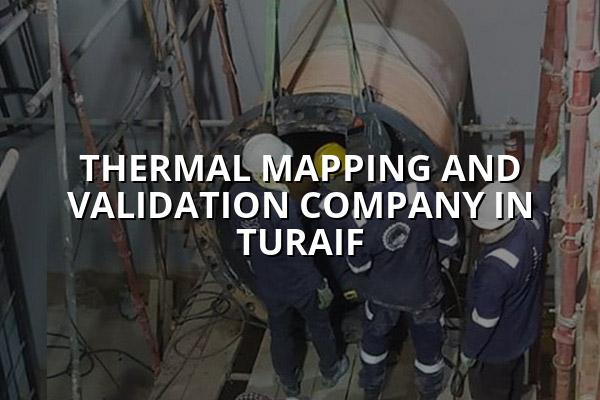
Thermal mapping and validation company in Turaif searches usually come from a real operational need: a cold room, freezer, reefer or chamber has to prove it holds temperature the way your QA team expects. We help you see the actual pattern inside the space, not just the number on one controller.
Our team works with cold-chain storage, warehouses, chambers and transport assets used around Saudi Arabia and the wider Middle East. For Turaif operations, that means studies that support product safety, traceability and cleaner internal audits without guesswork.
What thermal mapping and validation should show you
A proper thermal mapping study shows hot spots, cold spots, recovery behaviour and the places where air movement simply doesn't behave the way the drawing suggests. In cold rooms and warehouses, those weak points matter because pallets, door openings and loading patterns all change the profile. We usually see the difference between a stable room and a troublesome one within the first review of sensor data.
Why validation is more than a report
Validation is the part that gives your study practical value. It links the temperature profile to the way you actually use the room, so your team can decide where to place product, how often to open doors and what alarms need attention. In Saudi food, pharma and cold-chain work, that evidence is what managers ask for when they want confidence, not slogans.
What our team looks for on site
We look at the space, the load condition, the run duration and the sensor layout before we ever talk about the final output. A reefer vehicle, a freezer room and a walk-in chamber do not behave the same way, and the study has to reflect that. If the room is near a loading bay in Turaif or tied into a plant utility area, we factor that into the setup.
- Start with a site review — we check room size, equipment type, product type and how the area is used each day.
- Place sensors properly — logging points go across corners, doors, centre zones and any obvious problem areas.
- Run the study under real conditions — doors, load pattern and operating mode are kept close to actual use where possible.
- Read the data against acceptance needs — the results are reviewed so your QA team can see where the risks sit.
- Issue a traceable report — the findings are documented for internal records, audit review and future comparison.
- Use a mapping plan that covers doors, corners and return-air paths.
- Match the study to the actual product load, not an empty room only.
- Keep a record of door openings, setpoint changes and equipment alarms during the test.
- Compare the results with your own quality limits before putting the room back in service.
- Recheck after major changes, like new shelving, a compressor replacement or a room expansion.
Typical thermal mapping targets for controlled spaces
| Controlled space | Common focus | What we check |
|---|---|---|
| Cold room | Product holding stability | Corner variation, door-zone drift, recovery after access |
| Warehouse | Storage uniformity | Airflow pattern, stacking impact, hot and cold bands |
| Freezer | Low-temperature consistency | Setpoint stability, defrost effect, load influence |
| Reefer vehicle | Transport control | Cabin distribution, loading condition, route vibration impact |
| Thermal chamber | Process validation | Ramp behaviour, steady-state spread, repeatability |
Why Turaif sites need careful temperature mapping
Turaif sits in a working industrial corridor where cold-chain control matters just as much as in larger Saudi cities. A room that looks fine during a quick walk-through can still have a dead zone near the floor, a warmer strip by the door or a corner that never fully recovers after loading. That's where mapping earns its place.
Where the findings help most
Operations teams use the results to plan product placement, define acceptable operating conditions and decide whether a room needs airflow changes or maintenance work. In our experience, the most useful reports are the ones that make the next decision obvious. You shouldn't have to guess where the risk sits.
Built for QA, maintenance and procurement
We write studies so the people who use them can act on them. That means clear sensor placement notes, readable charts and a record that stands up to internal review. For procurement teams, it also helps when deciding if a room needs corrective work before the next shipment cycle.
What we check during a mapping exercise
Room behaviour
We check how temperature shifts from start-up to steady state and what happens after the door opens. That tells you where the real exposure sits.
Equipment condition
If the system is short-cycling, weak on airflow or showing uneven recovery, the study usually shows it. That gives maintenance a starting point.
Operational fit
We compare the mapped profile with the way you really use the room, not with idealised conditions that never happen on shift.
How Mayon Industrial Services Can Help
We support thermal mapping with the same disciplined approach we use in calibration, temperature control work and industrial inspection. If your Turaif site needs cold room mapping, chamber validation, reefer checks or follow-up maintenance support, our team can plan the study, gather the data and help you interpret the results. We also work across Saudi Arabia and the Middle East with onsite capability, so your team isn't left trying to coordinate a fragmented job.
Call +91 99447 80844 (India) or +966 59 633 8012 (Saudi Arabia), email services@mayonservices.com, or message us on WhatsApp.
Frequently Asked Questions
Any operation that stores temperature-sensitive goods should look at mapping early, especially cold rooms, freezers, warehouses and reefer vehicles. In Turaif, we usually hear from food, logistics and industrial teams that want proof their space behaves consistently across the full load range. That proof is useful before an audit, after maintenance or when a room starts acting strangely.
The timing depends on the size of the space, the operating pattern and what needs to be documented. A small room and a multi-zone warehouse don't need the same setup. We plan the study around your site conditions so the data reflects real use, not a quick snapshot that misses the problem areas.
We can map warehouses, freezers, thermal chambers and reefer vehicles, and we also handle other controlled environments tied to cold-chain work. The method changes with the asset. A truck body, for example, needs a different sensor layout from a fixed chamber because loading, airflow and access points behave differently.
Yes, we do onsite work in Saudi Arabia and across the Middle East. Our mobile calibration lab and field setup help when instruments or controlled spaces need practical support without moving everything offsite. If your site is in Turaif or a nearby industrial area, we can discuss the best way to handle the study.
Have the room layout, normal operating setpoint, product load plan and any recent maintenance notes ready. If there are access restrictions, planned shutdowns or door-opening patterns that matter, tell us before the visit. That saves time on site and helps the study reflect how your team really works.
Yes, and that's one of the most practical times to do it. After compressor work, airflow changes or a room expansion, the temperature pattern can shift in ways you won't see from the controller screen alone. A new study gives you a fresh baseline so you know whether the repair actually improved the space.
Ready to put temperature control on record?
If you need a thermal mapping and validation company in Turaif that understands cold-chain work and industrial QA, we’re ready to help.
Contact MayonFor teams in Turaif, the real value is a study that helps you make decisions with confidence. Mayon Industrial Services brings that practical, traceable approach to thermal mapping, validation and the wider support work that keeps your operation steady.