
Bolt Tensioning Service Company in Mecca
Controlled flange bolting for process lines, rotating equipment and shutdown work in Mecca, Makkah Province, and nearby Saudi industrial sites.
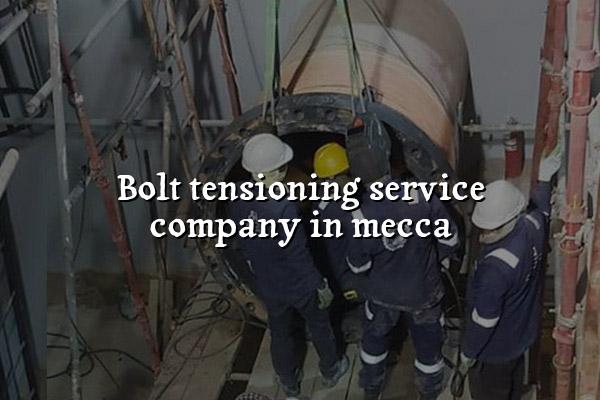
Bolt tensioning service company in Mecca is exactly what you need when a flange joint has to go back together without guesswork. We help teams control bolt load on process piping, exchangers, skids and pressure-retaining equipment so the joint clamp-up is even and the leak risk stays down.
Our work fits the reality of plant shutdowns, maintenance windows and commissioning jobs in Saudi Arabia. In Mecca and the wider Makkah region, site teams often deal with tight access, hot conditions and schedules that leave little room for rework, so we bring the right tools, a methodical crew and practical documentation to the job.
Bolt tensioning service company in Mecca for controlled flange work
When a flange is tightened with uneven torque, the joint can look fine at first and still give trouble later. Hydraulic bolt tensioning helps apply a more controlled and repeatable load, which is why maintenance managers, QA teams and shutdown planners ask for it on critical joints. We see it often on oil and gas skids, utility lines, thermal systems and packaged equipment where gasket seating really matters.
Where tensioning makes the most sense
Not every job needs tensioning, but some joints clearly benefit from it. Long bolt circles, large-diameter flanges, high-risk process services and joints that have failed after repeated tightening usually need a better method than hand torque alone. In our experience, once a plant has had one or two nuisance leaks, the conversation shifts from “tighten it more” to “control the load properly.”
What our crew does on site
We start by checking the joint condition, bolt size, thread condition and access around the flange. Then we plan the sequence, prepare the faces, use the correct tensioning equipment and tighten in a pattern that supports uniform load distribution. If the job also needs flange facing, hydrotesting or bolt torquing after tensioning, our mechanical team can support that too.
- Inspect the joint first — we check flange type, bolt grade, gasket condition and whether the faces are clean enough to trust.
- Prepare the assembly — threads, washers and mating faces are cleaned, and any damaged hardware is flagged before tightening starts.
- Set the tensioning sequence — the crew applies load in the planned order so the joint compresses evenly instead of pulling to one side.
- Verify and record — we confirm the final condition, note the work carried out and hand the job back ready for test or start-up.
- Use tensioning on critical flanges where uniform bolt load matters more than quick tightening.
- Check bolt condition before the job; worn threads can ruin load consistency.
- Keep the flange faces clean and aligned so the gasket is not crushed unevenly.
- Plan for access around the joint; cramped spaces slow the sequence and invite mistakes.
How bolt tensioning compares with common flange tightening methods
| Method | Best Use | Main Benefit |
|---|---|---|
| Hydraulic bolt tensioning | Critical flanges, larger joints, repeat work after leakage | More controlled and repeatable bolt load |
| Manual torque tightening | Routine maintenance on less sensitive joints | Simple setup and wide field familiarity |
| Torque with calibrated wrench | Planned shutdowns where access is decent | Better consistency than guesswork |
| Sequential re-tightening | Jobs needing a follow-up pass after initial assembly | Helps settle the joint after first load application |
Why Mecca projects ask for controlled bolt load
Many Mecca-area jobs involve plants that cannot afford repeated opening and closing of the same flange. That is where controlled bolt load helps. It supports cleaner gasket compression, reduces uneven seating and gives the maintenance team a more disciplined way to close the joint before hydrotest, start-up or handover.
Useful on oil, power and process equipment
We support jobs for oil and gas, petrochemical, power, manufacturing and cold-chain related facilities across Saudi Arabia. The same method also helps on heat exchangers, pump lines, condensate systems, utility headers and certain fabricated packages where accurate clamping is more useful than brute force.
Site-ready support, not just tools
Our crews are used to field conditions: limited access, permit windows, dirty plant areas and joints that need careful handling. If the scope also needs mechanical services, hydrotesting support, flange work or testing and commissioning, we can line those up in the same visit.
What to check before you book a bolt tensioning crew
Good bolt tensioning starts before the tool touches the flange. We ask for bolt size, flange class, gasket type and the job location so we can plan the equipment and crew properly. On real sites, that preparation saves time because no one wants to discover missing studs or damaged threads after the permit is already open.
Access is the other big one. If the flange sits behind pipe racks, close to hot surfaces or inside a tight equipment bay, the approach changes. Mecca projects often combine field constraints with short shutdown windows, so the team has to arrive ready to work cleanly and in sequence.
Typical jobs handled by a bolt tensioning service company in Mecca
Pipelines and headers
Flange closure on process lines where even seating matters.
Heat exchangers
Tube-side and shell-side joints that need tidy load control.
Pumps and skids
Packaged equipment that cannot tolerate uneven bolt loading.
Shutdown repairs
Reassembly after maintenance, inspection or leak correction.
How Mayon Industrial Services Can Help
We handle bolt tensioning alongside the wider mechanical scope, so you do not have to split the job between several vendors. If you need flange work, hydrotesting support, alignment checks, inspection, or commissioning help after the joint is closed, our team can keep the scope moving in one direction. For shutdowns, plant maintenance or critical reassembly in Mecca, we’re ready to plan the work with you.
Call +91 99447 80844 (India) or +966 59 633 8012 (Saudi Arabia), email services@mayonservices.com, or message us on WhatsApp.
Frequently Asked Questions
We use hydraulic tensioning equipment to apply controlled load to flange bolts, then close the joint in the right sequence. That helps on critical piping, exchangers and other pressure joints where even clamp-up matters. The goal is a cleaner, more repeatable assembly before hydrotest or start-up.
Choose tensioning when the flange is critical, the joint is large, or the service has already shown leakage after normal tightening. Torque tightening still has its place, and plenty of routine jobs use it well. For higher-risk joints, tensioning gives the crew better load control.
Yes, we support Saudi projects from our Mecca-focused work and our Dammam Industrial City 2 base through SMC Engineering Services / Sixfaces Maintenance Co. That lets us handle industrial maintenance scopes across the Kingdom and the wider Middle East. We plan around site access, permits and the actual work window.
We usually ask for flange size, bolt size, quantity of joints, site location, service media and access conditions. Photos help too, especially if the joint is inside a tight bay or has already been opened for repair. The more accurate the handover details, the better we can prepare.
Yes, we often combine tensioning with flange work, hydrotesting, bolt torquing, testing and commissioning, and related mechanical support. That matters because a joint is rarely the only item on the punch list. It is usually one part of a bigger maintenance scope.
Ready to close the joint with more control?
If you need a bolt tensioning service company in Mecca for shutdown work, repairs or critical flange reassembly, contact Mayon and we’ll help you plan the job properly.
Contact Mayon