
Flange Facing Service Company in Madina
Precision flange face correction for reliable sealing in refinery, plant and utility work.
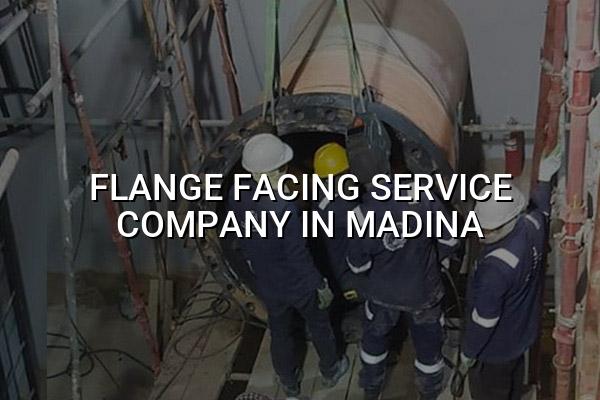
Flange facing service company in Madina searches usually come from a simple problem: a joint has started leaking, gasket marks look uneven, or the old flange face has pits, scoring or distortion. We help you correct that before the issue turns into a shutdown, repeat gasket failure or a messy hot work delay.
Our team works with plant crews, maintenance managers and shutdown planners across Madina, Dammam Industrial City 2, India and the wider Middle East. We bring onsite machining experience, ISO/IEC 17025:2017 discipline where traceability matters, and the practical approach that industrial work demands.
Flange facing service company in Madina for sealing faces that work
When a flange face is no longer true, the gasket has to fight for every millimetre. That means higher risk of leakage, uneven compression and more time spent chasing the same joint again and again. We see this in oil and gas skids, utility piping, pressure systems, heat exchangers and tank farm lines where a small defect becomes a major maintenance headache.
What flange facing actually fixes
Flange facing is a controlled machining process that restores the sealing surface of a flange. We use it when there is corrosion, scratches, weld spatter, impact damage or face distortion from previous work. In plain terms, the aim is to give the gasket a clean, even surface so the joint can seal the way it was meant to.
Where our work fits in a shutdown plan
Most clients do not ask for flange facing on its own. They ask for a field solution that fits into a larger job: valve replacement, exchanger maintenance, piping modification, hydrotesting, bolt torquing or commissioning. That is where our mechanical team helps. We can coordinate the facing work with cold cutting, flange weld testing, hydrotesting and final reassembly so you are not waiting on separate contractors.
- Inspect the joint first — we check the flange face, bolt holes, gasket seating area and surrounding pipe condition before any machining starts.
- Confirm the machining setup — the tool needs the right clamp, alignment and access, especially when the line sits in a tight rack or skid.
- Machine the sealing surface — the face is cut carefully to restore flatness and the correct finish for the gasket type.
- Verify fit-up and reassembly — we review the restored face, then support the crew during gasket installation, bolt tightening and pressure testing.
- Helps reduce repeat leakage on damaged or worn flange faces
- Suitable for refineries, petrochemical plants, utilities and manufacturing lines
- Can be planned alongside hydrotesting, torquing and commissioning work
- Supports onsite work where dismantling the line would cost too much time
- Useful when the original sealing face has corrosion, nicks or weld damage
Common flange face problems and what they mean on site
| Flange condition | What it looks like | Typical field response |
|---|---|---|
| Scored face | Visible grooves from tools, dirt or repeated gasket removal | Machine the face and check the gasket contact area |
| Corroded surface | Rust, pitting or uneven metal loss near the seal line | Assess remaining material and restore the face if safe |
| Distorted flange | Non-uniform face contact after heat, force or poor assembly | Measure alignment before facing and recheck after machining |
| Weld damaged edge | Spatter, arc strikes or heat marks near the sealing surface | Remove damage carefully and confirm no hidden defects remain |
Why a proper facing job saves time later
On a live plant, the flange face is not just a metal ring. It sits inside a system that depends on bolt load, gasket selection, surface condition and assembly discipline. If the finish is wrong or the face is not true, you often see the same joint fail again during pressure testing or after a short run period.
We keep the job practical
Our crews are used to industrial sites where access is awkward and time is tight. In Madina and across Saudi industrial zones, that often means working around dense piping, high-value equipment and shutdown windows that cannot slip. We plan the work to fit the job, not the other way around.
Field machining with a maintenance mindset
We are not there to turn a simple repair into a long story. The aim is clean contact, correct alignment and a face that gives your crew a fair chance of a good seal the first time.
How we plan a flange facing job from first call to handover
Every site is different, but the sequence is usually similar. We begin with the service history, flange size, material and location. Then we check whether the line can be isolated, whether the work is tied to a shutdown, and what other tasks have to happen around it. That early check saves a lot of wasted movement later.
Once the work starts, we stay focused on the actual sealing face. The machining has to suit the joint, the remaining wall condition and the pressure duty. If the line needs more than facing, we can coordinate related services such as inspection, bolt torquing, testing and commissioning support.
- Review flange size, material and service history before mobilisation
- Confirm whether the job needs onsite machining or a workshop-style setup
- Check access, isolation and the surrounding pipe layout
- Plan related tasks such as torquing, hydrotesting and commissioning
How Mayon Industrial Services Can Help
If you need a flange facing service company in Madina, we can support the job with onsite mechanical work, inspection, hydrotesting, bolt torquing and related maintenance tasks. We also handle precision calibration, so the measuring tools and test instruments used on your site stay within traceable control where that matters. That mix helps when you want one team that understands both the machine work and the measurement side.
Call +91 99447 80844 (India) or +966 59 633 8012 (Saudi Arabia), email services@mayonservices.com, or message us on WhatsApp.
Frequently Asked Questions
Usually it is a maintenance team dealing with a leaking joint, a damaged sealing face or a flange that failed after previous assembly work. We also get called when a shutdown crew wants to avoid replacing a whole spool or valve body. If the surrounding equipment is still sound, facing the flange can be the cleaner fix.
Yes, if the line is isolated and the access is safe for the machine setup. In our experience, onsite facing is often the better option for racks, skids and congested pipework where dismantling the line would take too long. The setup still needs care, because alignment matters just as much as the cut.
Pitting, scoring, gasket imprint damage, weld spatter and light distortion are the common ones. If the defect sits in the sealing area, the gasket cannot compress evenly, and that is where leaks start. A visual check is often enough to tell whether the face needs work, but the final call should be made with the actual joint condition in mind.
It does, because a poor sealing face can waste a hydrotest. If the face is repaired first, the joint has a much better chance of holding during pressure testing and commissioning. We often coordinate this with bolt torquing and other mechanical services so the sequence makes sense on site.
Oil and gas sites ask for it often, along with petrochemical plants, power facilities, manufacturing units and utility systems. We also see it in construction and engineering projects where piping integrity is part of the handover standard. The need is the same everywhere: a face that lets the gasket do its job.
Ready to restore the sealing face properly?
If the flange is damaged, don't wait for the next leak. Send us the job details and we'll help you plan the right repair path.
Contact Mayon